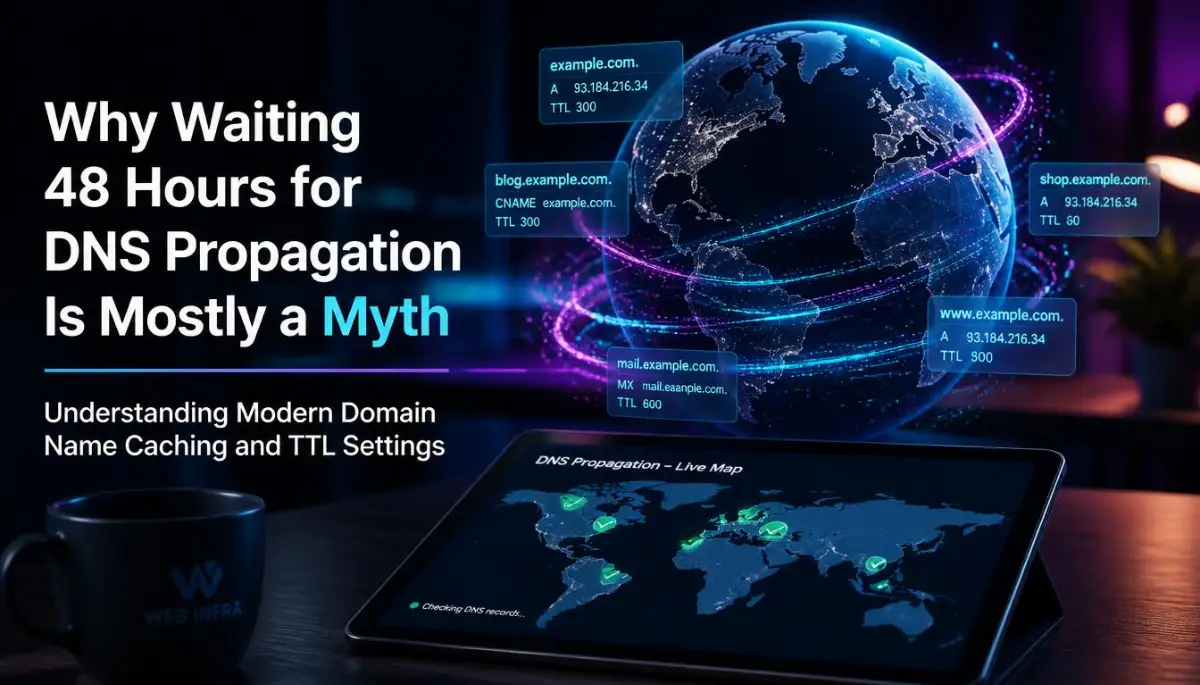
The Exhausting Wait That Stopped My Website Migration Cold
I remember sitting in front of my computer monitor three years ago, staring at a blank screen while my new website refused to load. I had spent six hours moving my files to a faster server, excited to show my clients the new layout.
I opened a live chat ticket with my domain registrar, begging them to tell me why my domain was still pointing to the old server. The support agent gave me the exact same line every website owner hears: "You just need to wait forty-eight hours for DNS propagation to complete globally."
I felt completely helpless, watching my business sit offline while time ticked away second by second. I refreshed my browser every ten minutes, hoping for a miracle that never seemed to come. That feeling of anxiety and wasted time is something almost every website manager experiences when changing servers.
When you migrate a website, being told to sit quietly and wait two full days feels like a nightmare. You worry about lost sales, missing emails from important clients, and search engines penalizing your site for being down. You feel trapped because you are told that internet physics is simply out of your control.
The worst part is that customer support teams use this standard phrase to shut down conversations when they do not want to troubleshoot local caching issues. They treat the global domain network like a slow cargo ship moving across the ocean. In reality, modern network updates travel across the globe in seconds, not days.
The idea that every domain change requires two full days to spread across the internet is mostly a relic of ancient network history. Once you understand how local memory caching works, you can bust this myth and control your migration timing with ease.

The Real Engine Behind Domain Name System Lookups
To understand why domain changes happen much faster than you think, we must look at how the domain name system operates. Your computer does not understand text names like website addresses. It relies on numerical network addresses to find the physical server housing your files.
Think of the domain name system as a giant phone book for the internet. When a user types your address into their browser, their computer asks a local internet directory for your server's current phone number. That local directory checks its notes and sends the user to your server's physical address.
A domain change simply means updating the phone number listed next to your name in that global directory. The change happens on your main authoritative directory server instantly the second you hit save. The only delay comes from smaller local directories holding onto old photocopies of your previous number.
Demystifying Recursive Resolvers and Local Memory Storage
When your internet browser requests a website address, it does not contact your domain host directly. Instead, it asks a middleman known as a recursive resolver, usually managed by your local internet service provider.
These middleman resolvers keep temporary copies of domain records in their short-term memory to save bandwidth. If every single internet request had to travel to your main domain server, the entire global network would ground to a halt. Caching domain answers locally makes web browsing feel snappy and instant.
The delay people call propagation is actually just these local middleman resolvers waiting for their cached copies to expire. Once the cached copy expires, the resolver is forced to ask your main nameserver for fresh data. That fresh request retrieves your new server address instantly.
Time To Live Settings: The Real Control Switch
Every domain record has an invisible timer attached to it called Time To Live, or TTL. This timer tells middleman resolvers exactly how many seconds they are allowed to store your domain information before checking for updates.
If your domain TTL is set to 86400 seconds, resolvers will hold onto your old address for twenty-four hours. If your TTL is set to 300 seconds, resolvers will throw away the old record and fetch your new server address every five minutes.
The length of your propagation delay is almost entirely dictated by the TTL value you chose before making the change. If you lower your timer to five minutes a day before your migration, your entire domain update will complete worldwide in just five minutes.
I used to leave my domain timers on default settings, which forced my site migrations to lag behind for a day. I later realized that simply reducing my TTL settings twenty-four hours before a move made my server transitions happen in under ten minutes. Managing your timers before touching your server files saves you from endless hours of nervous waiting.
Authoritative Nameservers vs Local Internet Cache
When you update your domain records, your authoritative nameservers update their master files within a fraction of a second. Anyone making a direct query to your master nameservers will see your new server IP immediately.
The delay only exists for users whose local internet providers are storing an old cached answer. Different internet providers refresh their cached answers at different times based on their internal rules.
This is why your friend across town might see your new website while you are still seeing the old server on your home computer. It is not that the change is slowly crawling across physical geography. It simply means your local internet provider has not cleared its temporary memory drawer yet.
Want to see a real-time global lookup of how nameservers resolve domain records across continents? Watch this quick visual guide to understand domain caching maps!
The Ancient History Behind the 48-Hour Delay Rule
Where did the famous forty-eight hour rule actually come from if modern updates happen in minutes? Decades ago, early internet networks relied on slow dial-up connections and batch-processing updates that ran once a day.
Domain registries updated their central root zone files on strict, slow schedules. Nameservers had limited processing power, so holding onto domain records for days was necessary to keep the early internet stable.
Modern domain registries update their root zones almost continuously using high-speed network connections. According to domain governance standards outlined by ICANN Beginner DNS Resources, root zone updates propagate through authoritative systems within minutes. Continuing to quote ancient forty-eight hour timelines ignores decades of network infrastructure improvements.
Why Internet Service Providers Ignore Standard Rules
While modern standards encourage fast updates, some internet service providers play by their own rules. A few smaller or older internet providers intentionally ignore short TTL settings set by website owners.
These providers force domain records to stay in their memory cache for a minimum fixed time to cut down on their own data bandwidth costs. If your local provider enforces a forced minimum cache time, your computer will keep seeing the old site until their forced timer expires.
This rogue caching behavior is the primary reason why a tiny percentage of users experience long delays. It has nothing to do with global propagation traveling across the world. It is simply your specific local internet provider refusing to clear its internal memory drawer on time.
Common Myths About Domain Record Propagation
- Myth: Domain propagation travels physically across the world from west to east like a slow wave.
- Reality: Updates happen instantly on master servers; delays depend entirely on when local internet providers clear their cache memory.
- Myth: You cannot do anything to speed up domain propagation once you hit save.
- Reality: Lowering your TTL settings a day before your migration forces local resolvers to fetch your new IP address within minutes.
- Myth: If a global checker shows green checkmarks, every single person on Earth can see your new site.
- Reality: Global checkers ask clean public resolvers, but individual users might still be stuck on their local internet provider's stale cache.
How Local Operating Systems and Web Browsers Trap Old Records
Sometimes the delay is not even coming from your internet service provider. Your personal computer and web browser maintain their own internal DNS caches to speed up page load times.
Your computer saves the IP addresses of websites you visit frequently in its local system memory. When you attempt to open your domain after a server move, your computer reads its local memory and sends you back to the old server.
Your web browser also holds onto old connections to keep pages loading fast. Sometimes a site issue feels like a server error when it is actually just stale browser memory. If your page hangs or acts strangely on a fast connection, check out fast Wi-Fi but slow pages to learn how local browser caching stalls website loading.
The Difference Between Changing IP Records and Nameservers
It is vital to understand the difference between updating an A record and changing your root nameservers entirely. Updating an A record keeps your existing nameservers but points your domain to a new server IP address.
A record updates strictly obey your configured TTL timers and usually resolve within minutes if your timer was set low. Changing your root nameservers at your domain registrar is a slightly larger administrative change.
Nameserver changes require your domain registrar to update the top-level domain directory for your extension. While top-level directories update quickly today, some local resolvers store root nameserver records for longer periods. Understanding this difference helps you choose the fastest migration path for your project.
How Public Resolvers Bypass Provider Delays
If you are stuck waiting for a sluggish internet service provider to update its cache, you can bypass them completely. Public DNS resolvers operated by tech companies allow you to bypass your provider's slow local memory.
Services like Cloudflare DNS or Google Public DNS update their internal cache records instantly according to standard TTL rules. Switching your computer's network settings to use a public resolver lets you see your new server immediately.
This simple network tweak proves that your new website is live and working for the rest of the world. It frees you from being held hostage by your local provider's lazy caching rules.
How Content Delivery Networks Handle Record Changes
Content delivery networks add another layer of caching between your domain records and your web server. When you use a content delivery service, your domain points to their global edge proxy network instead of your host.
Updating your server IP inside a content delivery dashboard bypasses standard domain propagation entirely. The edge proxy updates its internal routing table across all global data centers in a matter of seconds.
Visitors connecting to the edge proxy are routed to your new server IP immediately without waiting for local resolvers to expire. Using an edge network proxy is one of the most effective ways to achieve zero-downtime server migrations.
Why Mobile Networks Update Faster Than Home Connections
Have you ever noticed that your phone's cellular network sees your new website hours before your home Wi-Fi does? Mobile networks process millions of rapid location changes and network hops every single minute.
Because mobile networks handle constant data movement, their internal resolvers are built to clear memory caches quickly. They enforce strict adherence to short TTL timers to ensure mobile apps connect to active servers.
Testing your website migration over a mobile cellular connection gives you an accurate view of your live status. If the site loads fine on your phone's data connection, your migration was successful and your home Wi-Fi is simply caching old data.
Understanding Negative Caching and Broken Lookups
There is a lesser-known form of caching that can cause major confusion during a server move known as negative caching. Negative caching occurs when a resolver attempts to look up your domain while your settings are broken or mid-update.
If a resolver receives a "domain not found" answer, it stores that failure in its memory cache for a specified time. Even after you fix your domain settings, the resolver will continue serving that error message until its negative cache timer expires.
Standards defined in official network documentation from IETF RFC 1035 Domain Specifications govern how negative caching timers protect nameservers from repeated broken requests. Avoiding configuration typos during your update prevents recursive resolvers from caching a failed lookup state.
Proactive Strategies to Achieve Instant Domain Updates
Waiting for domain updates to spread across the internet should never be a guessing game. By building a clean migration workflow, you can move servers smoothly without losing a single visitor.
Pre-Migration TTL Reduction Checklist
The single most effective trick for fast domain propagation must be performed twenty-four hours before you move any files. Log into your domain management console and locate your A records.
Lower the TTL timer on your main A record from its default setting down to three hundred seconds. Leave your domain running on its old server for a full day so global resolvers adopt this short timer.
When you finally change your server IP address the next day, resolvers around the world will hold onto the old address for only five minutes. Your entire global audience will transition to your new server seamlessly.
Clearing Local Operating System DNS Caches
When testing a newly migrated website, your own computer is often your worst enemy because it stores stale IP addresses. Flushing your local operating system DNS cache forces your computer to fetch fresh network records immediately.
Your operating system clears its internal address directory and sends a fresh query to your designated nameserver. This quick step removes local caching as a variable and shows you the true state of your domain.
Learning how your operating system manages temporary memory files helps you troubleshoot local system delays. If you are curious about how temporary storage clutters system performance, explore the silent culprit behind your lagging smart devices to learn how memory buildup slows down hardware. Keeping your local cache clean prevents confusion during critical site migrations.
Using Global Propagation Monitoring Tools
Instead of relying on your personal internet connection to check migration status, use public global monitoring tools. Global propagation services query dozens of recursive resolvers located on every continent simultaneously.
These tools display a clear visual map showing which geographic regions have adopted your new IP address. If Europe and Asia show green checkmarks while your local region shows red, you know your new server is working fine.
You can confirm that global network proxies are handling your traffic by referencing technical documentation from the Cloudflare DNS Learning Center guides. Monitoring global status maps gives you confidence that your migration is progressing normally worldwide.
Bypassing Local Cache with Custom Host File Overrides
If you need to work on your new server before telling the rest of the world to move, use a local host file override. Your computer's host file sits above all network resolvers and dictates where domain names point locally.
Adding your new server IP alongside your domain name in your local host file forces your computer to load the new server directly. The rest of the world continues visiting your old server while you test your new site setup in complete privacy.
Once you confirm your new site works perfectly, you can update your public domain records with complete peace of mind. Remember to remove the custom entry from your host file after the public migration completes.
Forcing Public Resolvers to Flush Stale Memory
Major public DNS providers offer web tools that allow site owners to manually purge cached domain records from their systems. If Google or Cloudflare is serving an old IP address for your domain, you can submit a purge request directly.
Visiting specialized flushing tools like the Google Public DNS Cache Purge Tool lets you clear stale domain answers instantly. Submitting your domain name forces their global network to query your authoritative nameservers for a fresh answer immediately.
This proactive step speeds up propagation for millions of internet users who rely on public DNS resolvers. It is a powerful secret weapon for web administrators managing high-traffic domain migrations.

Dangerous Pitfalls That Cause Real Migration Delays
When people experience long domain propagation delays, it is almost always caused by self-inflicted administrative errors. Avoiding these common traps keeps your domain updates fast and clean.
Changing Nameservers and A Records Simultaneously
One of the most chaotic mistakes is changing your domain's root nameservers and editing your A records at the exact same moment. This creates a confusing network loop where resolvers do not know which authoritative server holds the correct answer.
Some resolvers will check your old nameservers, while others attempt to reach your new nameservers before they are fully active. This creates random lookup failures and triggers negative caching across intermediate resolvers.
Always move your domain records in staged steps rather than doing everything at once. Copy your existing A records to your new nameservers first, make sure the new nameservers are active, and then update your registrar settings.
Panic-Changing Settings Mid-Migration
When a website owner sees their site loading slowly after a move, panic sets in quickly. They begin clicking buttons, changing IP addresses, and toggling settings back and forth every few minutes.
Every time you edit a domain record, you reset the TTL timer on recursive resolvers around the world. Continually changing your settings creates a mixed cache environment where different users get sent to different servers for hours.
If you made a domain change, step away from your keyboard and let the TTL timer run its course peacefully. Constant tampering only extends your downtime and makes troubleshooting impossible.
Ignoring Domain Registrar Security Locks
Domain registrars include security locks to prevent unauthorized users from stealing your domain name. Trying to update your root nameservers while a registrar lock is active results in a silent update failure.
Your registrar dashboard might show that your request was submitted, but the top-level domain directory will reject the change. Your domain remains stuck on your old nameservers indefinitely until you unlock the domain and re-submit the request.
Always check your domain's security lock status and transfer settings before attempting a nameserver migration. Verifying your administrative access beforehand prevents mysterious update blocks at the registry level.
Forgetting Mail Exchange Records During Server Moves
Focusing entirely on web page files often causes site owners to forget about their business email routing. If your email server IP is tied to your main web server A record, changing that record without planning will break your incoming email.
Inbound messages will bounce back to senders or disappear into the void while resolvers try to reach an unconfigured mail server. Losing critical client emails during a site launch causes severe business disruption.
If you want to streamline your digital tasks, smart software can automate complex routine workflows easily. Read about AI tools that cut your work time in half to discover how modern automation keeps your business operations running smoothly. Always separate your mail exchange records from your main web server IP before starting a domain move.
Misunderstanding Cloud Storage Caching Rules
Moving media files or assets to remote cloud folders during a migration can introduce secondary caching delays. Web pages might point to new server addresses while image assets remain cached on old cloud storage links.
Unsecured cloud storage buckets can also expose your private site assets to unwanted public access. Explore the dangerous reality of free cloud storage to understand how to properly secure your offsite digital files during a move. Ensuring your cloud links use clean, secure paths keeps your migrated site loading fast.
Your Blueprint for Stress-Free Domain Migrations
Migrating a website to a new server does not have to be a scary, unpredictable experience. By discarding the forty-eight hour myth and taking control of your domain settings, you can execute fast, flawless transitions.
- Step 1: Lower your A record TTL timer to 300 seconds full twenty-four hours before your planned migration.
- Step 2: Copy all website files, databases, and mail records to your new server host and test using local host files.
- Step 3: Update your main A record to point to your new server IP address.
- Step 4: Flush your local operating system DNS cache and use global propagation maps to monitor global resolution.
- Step 5: Restore your TTL timers back to standard values once global propagation completes successfully.
Taking Control of Your Domain Management
Domain infrastructure might feel mysterious, but it operates on clear, logical rules that you can easily master. You do not have to accept long downtime or sit helplessly waiting for magical timers to expire.
By managing your TTL values and understanding how internet caching works, you can move servers with total confidence. Start by checking your domain's current TTL settings today so you are prepared for your next smooth migration.
I know how stressful it feels to watch your website sit unreachable while support agents tell you to wait two days. After managing dozens of fast server moves on my own projects, I promise that taking control of your TTL timers today will make long migration delays a thing of the past.
Common Questions About Domain Propagation Delays
Is the 48-hour DNS propagation delay real for any type of change?
The forty-eight hour delay rule is mostly an outdated guideline from early internet history. Modern A record updates complete within minutes if you lower your TTL settings beforehand, though some root nameserver changes can occasionally take up to twenty-four hours on sluggish provider networks.
How can I check if my domain has propagated in other countries?
You can use free online global DNS propagation checking tools that query nameservers in dozens of countries simultaneously. These tools display a visual map showing real-time IP resolution across different continents.
Why does my phone load my new website but my home computer still shows the old one?
Your mobile phone network uses fast, frequently cleared DNS caches, while your home Wi-Fi provider or local computer operating system may still be holding onto a stale cached record. Flushing your computer's DNS cache usually fixes this mismatch immediately.
Will changing my domain IP address hurt my website's search engine rankings?
Updating your domain IP address will not hurt your search engine rankings as long as your new server is fast and your site experiences minimal downtime. Lowering your TTL settings beforehand ensures search engine bots find your new server IP smoothly without hitting broken pages.
What happens if I forget to lower my TTL before migrating my server?
If you forget to lower your TTL, global resolvers will continue serving your old server IP until your default TTL timer naturally expires. Depending on your original settings, this means some visitors may take up to twenty-four hours to see your new site.
How do smart algorithms handle domain changes behind the scenes?
Modern network systems use lightweight predictive algorithms to route user requests along the fastest available paths. If you want to understand how these smart systems process data patterns simply, explore understanding artificial neural networks simply for an easy overview.
What should I do if my server throws errors right after updating my domain IP?
If your domain points to your new server but shows system errors, the problem sits on your new server host rather than the domain system. Check out our guide on what your server is trying to tell you during a 502 error to diagnose and fix backend server communication failures.
Disclaimer
The information provided in this article is for educational and informational purposes only. Domain configurations and network settings vary based on registrars, hosting providers, and local operating systems. Always back up your domain zone files and website data before performing domain record updates or server migrations.


