The Monthly Illusion of Safety: Why Your Mailbox Brings Silent Dread
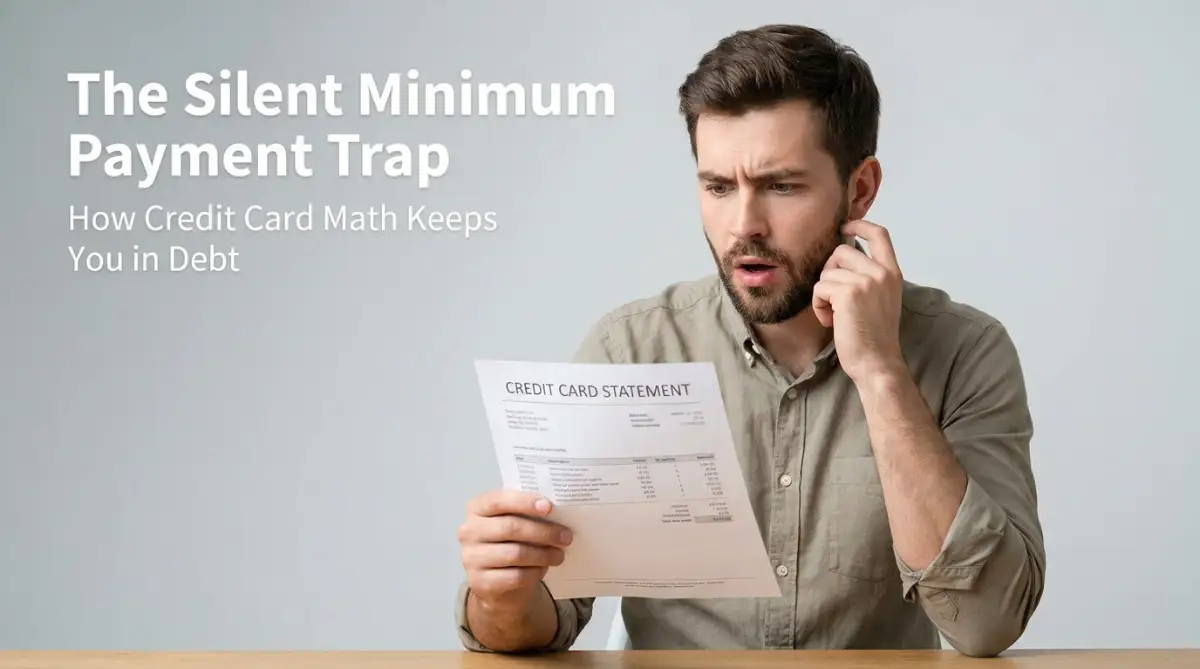
Do you know that feeling of relief when you open your credit card statement and see a very low minimum payment?
I remember the exact day I finally looked closely at my credit card statement instead of just blindly paying the bill. For three years, I had been paying a tiny fifty-dollar minimum on a high balance, honestly thinking I was doing a great job managing my money.
When I realized my actual debt had barely moved because the interest charges were eating almost my entire payment, I felt completely sick to my stomach. I was caught in a system designed to keep me paying forever, and I knew right then that I had to find a way out.
You owe three thousand dollars, but the bank says you only need to pay sixty dollars this month.
You pay the sixty dollars, tell yourself everything is under control, and go back to your day.
But behind that small, friendly number lies a highly calculated trap designed to keep you in debt for the rest of your life.
Every single month, millions of people fall into this quiet cycle of financial slavery.
They feel a temporary sense of safety, not realizing that their hard-earned money is slowly being drained away.
This endless cycle creates a state of constant, low-level anxiety that affects your sleep and your relationships.
You feel like you are working incredibly hard, yet your credit card balances never seem to actually go down.
The mental exhaustion of carrying this balance makes you feel stuck, as if you are running on a treadmill that never stops.
Let us look at the cold, hard numbers behind this system so you can reclaim your peace of mind.

Cracking the Code of the Compound Interest Treadmill
To understand why the minimum payment is a trap, we have to look at how credit card companies calculate your monthly bill.
Lenders do not calculate this number to help you pay off your debt quickly.
Instead, they calculate it to maximize the amount of interest they can legally collect from you over time.
The Shocking Reality of the Math
Let us look at a real-world scenario to see exactly how this works in your daily life.
Before we break down the real numbers, take a quick look at this short video that perfectly explains how credit card compound interest actually works behind your back. It is a real eye-opener that will make the math we are about to discuss so much easier to understand!
Imagine you have a three-thousand-dollar balance on a card with a twenty-two percent annual interest rate (APR).
Your bank calculates your minimum payment as two percent of the total balance, which comes out to sixty dollars.
You pay the sixty dollars, thinking you have made a decent dent in what you owe.
But let us look at where that sixty dollars actually goes behind the scenes:
- Your monthly interest charge is calculated by dividing your APR by twelve months, which is about one point eighty-three percent.
- One point eighty-three percent of your three-thousand-dollar balance is fifty-five dollars.
- This means that out of your sixty-dollar payment, fifty-five dollars goes directly to the bank as pure interest.
- Only five dollars actually goes toward reducing the three-thousand-dollar principal you borrowed.
This means you still owe two thousand nine hundred and ninety-five dollars to the bank.
At this rate, it will take you over twenty years to pay off that three-thousand-dollar debt.
In the end, you will have paid the bank thousands of dollars in interest for a purchase that originally cost much less.
Myth vs. Reality: The Minimum Payment Trap
Paying the minimum monthly payment keeps my credit profile in perfect standing. It keeps your account active, but high utilization can actively damage your credit score. The minimum payment is a suggested amount to help me pay off my card balance. It is a calculated minimum designed to prolong your debt and maximize bank interest. I am saving money by keeping my monthly cash payments as low as possible. You are paying a massive premium over time through compounding interest charges.
Why the Balance Never Seems to Budge
The reason your balance stays the same is because of a process called compounding interest.
Every month you do not pay your balance in full, the bank adds the unpaid interest to your principal balance.
The next month, they charge you interest on the previous interest, creating a snowball of growing debt.
It is like trying to climb up a sliding hill; for every step forward, the ground slides two steps back.
This is why credit card debt is so uniquely dangerous compared to other types of loans.
Without a clear plan to pay more than the minimum, you will remain trapped on this financial treadmill indefinitely.
Step-by-Step Guide to Breaking the Interest Loop
Breaking free from this cycle does not require you to have a massive bank account.
It requires a simple shift in how you make your monthly payments.
Step 1: Establish Your Fixed Payment Anchor
Instead of letting the bank tell you how much to pay, set your own fixed monthly payment.
My biggest early mistake was blindly trusting the credit card company to tell me how much I should pay each month.
Once I started ignoring their suggested "minimum payment" box and simply sent a fixed amount every single month—even as the minimum requirement dropped—my balance finally started going down fast. It felt amazing because I realized I had finally taken the steering wheel back from the bank.
Look at your budget and decide on a fixed amount that is higher than the minimum payment.
For example, instead of paying the sixty-dollar minimum, commit to paying a fixed one hundred and fifty dollars every single month.
As your balance decreases, the bank’s suggested minimum payment will drop, but you must keep your payment at one hundred and fifty dollars.
This constant pressure quickly crushes the principal balance, saving you years of interest payments.
Step 2: Implement the Micro-Payment Strategy
You do not have to wait until the end of the month to make a payment on your credit card.
Every time you receive a paycheck or get extra cash, make a small payment immediately.
These small, frequent payments are often called "payment snowflakes."
Because credit card interest is calculated daily, making frequent payments reduces your average daily balance.
This small habit shift directly reduces the amount of interest the bank can charge you at the end of the month.
It is an incredibly easy way to trick the system and save money without changing your lifestyle.
Comparison: Minimum Payments vs. Fixed Payments
To see the massive difference this shift makes, let us compare the two methods on a three-thousand-dollar balance at twenty-two percent interest:
Step 3: Aligning Payments With Your Income Cycle
To make this plan sustainable, you must align your payments with your paychecks.
If you get paid twice a month, split your fixed payment into two smaller payments.
Make one payment on the tenth of the month and the second payment on the twenty-fifth.
This ensures that the money is sent to the bank before you have a chance to spend it on daily temptations.
It creates a natural flow of cash that protects your budget from sudden, unexpected end-of-month pinches.
Pro Tip: Use a Visual Debt Tracker
Draw a simple progress bar on a piece of paper and tape it to your mirror. Mark your credit card balance at the top and zero at the bottom. Color in the bar as your balance drops each month. This physical tracker provides a sense of accomplishment that keeps your brain motivated to pay off the debt.
Moving Toward Real Financial Peace
To wrap things up, the minimum payment is not a financial tool; it is a business strategy used by credit card issuers.
You do not have to accept this endless cycle of interest payments as a normal part of your life.
By choosing to pay a fixed amount each month, you take back control of your financial destiny.
The shift from feeling powerless to feeling in control is an incredible boost to your mental well-being.
You will start to look forward to opening your statements because you will finally see the balances dropping.
Take that first step today, calculate your fixed monthly payment, and start reclaiming your financial freedom.
Aggressive Strategies to Shatter the Minimum Payment Chain
Once you understand how credit card companies calculate your monthly minimums, you can use advanced techniques to fight back.
These expert-level strategies are designed to help you pay off your card balances faster while saving thousands of dollars in interest charges.
The first step is to actively negotiate with your credit card issuer to lower your interest rate.
Many people do not realize that a simple, polite phone call can result in a significant drop in your interest rate.
According to reports from the Consumer Financial Protection Bureau, high interest rates are the primary reason why borrowers get trapped in endless repayment cycles.
You can call the number on the back of your card and use a simple script to ask for a rate reduction.
Explain that you have been a loyal customer but are currently looking at options to transfer your balance to another bank because of the high rate.
Often, the customer retention department will offer you a lower interest rate just to keep your account open.
Strategic Restructuring to Lower Borrowing Costs
If you are carrying balances on multiple cards, managing several high-interest accounts can become mentally exhausting.
In such cases, you might want to consider consolidating your credit cards into a single personal loan with a lower interest rate.
This approach replaces several unpredictable, high-rate credit card balances with a single, fixed monthly payment.
However, you must be extremely careful to avoid predatory terms when looking for consolidation loans.
To protect your budget, make sure you understand the common loan approval mistakes to avoid before you sign any new agreement.
Taking the time to research your options ensures you do not replace one high-interest trap with an even worse lending contract.
If a consolidation loan is not the right fit, you can use structured repayment plans to systematically attack your balances.
Many borrowers find incredible success by using the snowball method, which focuses on paying off their smallest credit card balances first to build emotional momentum.
You can read our comprehensive guide on demystifying the debt snowball strategy to see how small victories can help you pay off debt faster.
The Automated Windfall Boost
To make your debt payoff plan move even faster, you should create a rule for any unexpected money you receive throughout the year.
Most people treat tax refunds, work bonuses, or cash gifts as "free money" to be spent on luxury items.
Instead, try committing at least eighty percent of every windfall directly toward your active credit card balance.
Do's and Don'ts for Escaping the Credit Loop
- Do call your card issuer once every six months to politely ask for a lower interest rate.
- Do review your credit card statements at the end of every week to catch tiny spending leaks.
- Don't close your oldest credit card accounts as soon as they are paid off, as this can lower your credit score.
- Don't hide your financial goals from your family; support from loved ones makes the journey much easier.

Hidden Hazards: The Emotional Mistakes That Prolong Debt
Even the most dedicated people can stumble on their way to financial freedom by making simple, avoidable errors.
These mistakes act like quiet leaks in a boat, slowly draining your energy until you feel like giving up entirely.
Understanding these traps beforehand is the best way to ensure you do not fall into them.
The most dangerous pitfall is what I call the "Credit Card Mirage."
When you make your monthly payment and see your available credit limit increase, you might feel like you have extra money to spend.
This is a dangerous illusion because using that open credit line immediately resets your debt-payoff progress to zero.
If you continue to use your credit cards for casual purchases while trying to pay them off, you will remain trapped in debt forever.
To make real progress, you must stop using the cards entirely while you are paying them down.
Consider locking your cards in a drawer or deleting them from your favorite online shopping apps to add physical friction to your spending habits.
According to consumer alerts from the Federal Trade Commission, high-interest credit card debt can quickly lead to severe financial distress if left unchecked.
If you find yourself struggling to make even the minimum payments, you risk severe damage to your credit score.
Worse, you could find yourself missing a loan monthly payment on your other essential obligations, creating a massive financial emergency.
Another common mistake is throwing every single dollar of your extra cash at your credit card balances without keeping any emergency savings.
While paying off debt is important, living with zero savings leaves you completely exposed to sudden life events.
If your car breaks down or you face a medical emergency, you will be forced to use your credit cards again.
This sudden return to borrowing can be incredibly discouraging, often causing people to abandon their entire debt-free plan.
To avoid this, build a small, five-hundred-dollar emergency cushion before you begin aggressively paying down your credit cards.
This tiny cash buffer acts as a shield, ensuring you never have to slide back into debt when things go wrong.
Your Action Plan for Tomorrow: Reclaiming Financial Control
The journey to financial peace does not require giant leaps; it is built on small, daily choices.
You do not have to live under the shadow of credit card debt forever.
By choosing to pay a fixed amount each month instead of the minimum, you take back control of your financial destiny.
Your Daily Checklist to Break the Credit Loop
To help you take immediate action, here is a simple checklist you can complete tomorrow morning:
- Review Your Statements: Open your credit card accounts and write down your exact interest rates.
- Call for a Lower APR: Contact your card issuer and use our script to ask for a lower interest rate.
- Set Your Fixed Payment: Determine a fixed monthly payment that is higher than the suggested minimum.
- Lock Your Cards: Remove your credit cards from your daily wallet and digital shopping profiles.
- Create a Progress Tracker: Draw a simple paper chart to track your balances as they drop to zero.
The shift from feeling powerless to feeling in control is an incredible boost to your mental well-being.
You will start to look forward to opening your statements because you will finally see your balances dropping.
Take that first step today, calculate your fixed monthly payment, and start reclaiming your financial freedom.
Getting out from under that heavy credit card balance was one of the hardest but most rewarding things I have ever done.
It might feel a bit scary to send extra money to the bank this month, but the peace of mind you get when that balance finally hits zero is absolutely priceless.
You have the power to break this stressful cycle today, so pick a new fixed payment amount and start building the peaceful life you deserve.
Disclaimer
This article is for educational and informational purposes only and should not be taken as professional financial, legal, or tax advice. Personal finance situations vary greatly, and you should consult with a certified financial planner or professional advisor before making any major financial decisions.